

Jito is pushing forward a new governance proposal to allocate all revenue from its trading platform JTX to the DAO for the automatic buyback and burning of JTO tokens. The announcement indicates that this proposal, named JIP-38, was put forward by Dr. Nick Almond, Head of Governance at the Jito Foundation, and aims to clearly define Jito as a token-centric network.
JTX plans to use all of its revenue for share buybacks and destruction.
Under the current arrangement, 80% of the transaction fees from Jito Labs' trading platform JTX go to Jito DAO, while 20% is retained by JTX for future development. JIP-38 proposes to use all of this revenue flowing to the DAO to buy back and burn JTO, rather than leaving it to the treasury to decide on expenditures.
If the proposal is approved, this commitment will take effect from the launch of JTX and will continue until the governance review in the fourth quarter of 2027. During this period, any change in the allocation of funds will require a separate governance proposal.
The proposal states that the relevant processes will be executed on-chain, and token holders can view the collection, repurchase, and burning of transaction fees in real time.
The governance documents will be updated simultaneously.
Jito stated that this proposal is intended to respond to industry discussions about whether value should belong to the protocol's tokens or equity in the development company. According to the proposal, the protocol's primary revenue will continue to belong to the DAO, with token holders deciding how it will be used.
However, the 20% of JTX fees reserved for development remains a long-term exception, used to support ongoing product development. The proposal also states that governance retains the right to decide on the use of revenue; in the future, it can choose to repurchase and burn the revenue or redirect it to growth programs such as subsidies and incentives. However, any adjustments made during the commitment period will require a separate vote.
In terms of the division of responsibilities, the Development Committee will be responsible for the revenue distribution module, the CSD will be responsible for the buyback commitment and data analysis, and the Foundation will be responsible for JTX fee routing and governance updates. The proposal states that the buyback funds will come from JTX revenue and will not use existing treasury funds.
Jito is simultaneously advancing BAM expansion.
This proposal comes as Jito continues to advance its Block Assembly Marketplace, or BAM for short. Launched in September 2025, this system aims to improve the efficiency of Solana block production and transaction execution.
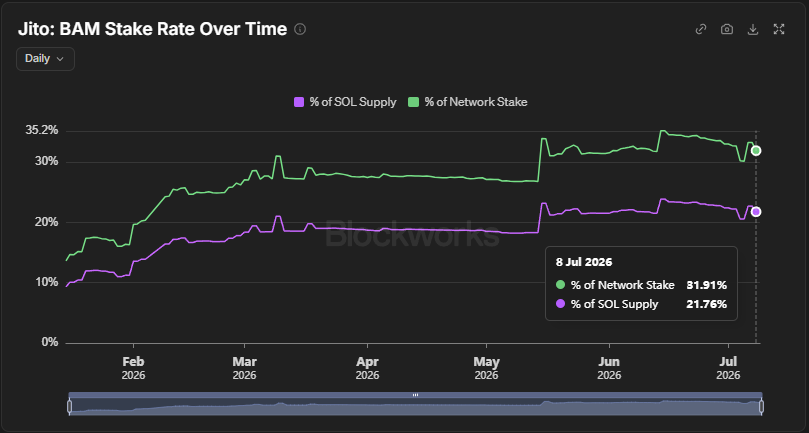
Jito disclosed that Solana currently has 715 validators, of which 369 are running the BAM client, accounting for 51.6%. The SOL staked by these validators accounts for 31.9% of the total network, approximately $10.65 billion.
Since 2026, the staking percentage of the BAM-covered network has increased from approximately 12% to 32%, the number of validators has increased from 223 to 369, and the total staking amount of these validators has exceeded 80 million SOL. On July 13, Jito also launched a new BAM node in Hong Kong to expand its data center coverage.
Additional information:Besides BAM, Jito stated that its main revenue streams, such as JitoSOL and Block Engine, already belong to the DAO. If JIP-38 is approved, JTX will become the latest revenue stream to be integrated into JTO's automatic buyback and burn mechanism.