JUST (JST) is a cryptocurrency with market cap $0.7B, ranked #81. JUST (JST) is a cryptocurrency with market cap $0.7B, ranked #81.
Who is the founding team of JST and what is their background?
JUST has a dedicated development team. JUST has a dedicated development team.
What are the important milestones in the development history of JST?
What is the technical architecture and infrastructure of JST?
JUST operates as a blockchain protocol. Homepage: https://www.just.network/. Whitepaper: .
What are the characteristics of JST’s economic model?
JUST total supply: 8815108920.581306, circulating supply: 8815108920.581306.
What governance model does JST adopt?
JUST is governed by JST token holders through on-chain voting. JUST is governed by JST token holders through on-chain voting.
What are the main application scenarios and ecological development of JST?
JUST is used for various blockchain applications. JUST is used for various blockchain applications.
Order Book
Latest
Large Trades
Price (USDT)
Amount (JST)
Total (JST)
$0.104
$0.10
81%
18%
Bullish
Bearish
Community
kvc.eth @AI CryptoGame
23m ago
Follow
Stay away from the crypto world; someone tried to run off with $20 million in assets.
What's that in the AI world...? The truth is out.
There's nothing left to do.
Just go back to Web2, make some games, AI, short dramas. $100,000 a day, isn't that great?
377
0
0
38
Titan
1h ago
Follow
#Bitcoin
Since the start of this bear market, the monthly fair value gap has eased before price pullbacks.
A new monthly fair value gap has just appeared.
I expect the same pattern to continue: at least until price pulls back or the gap is broken completely.
438
0
0
39
The Bitcoin Historian
1h ago
Follow
The former president of PayPal just stated that the "Clarity Act on Bitcoin and Cryptocurrencies" must be passed immediately; this is crucial.
"We need clear rules for the United States."
"We need to continue leading the global financial system."
He believes that once the bill becomes law, all U.S. banks will quickly adopt it.
The Clarity Act must pass this week! 🔥
441
0
0
42
0xSiyuan
1h ago
Follow
Many are still debating whether AI will replace humans, but what will truly determine the landscape of the next few decades may not be AI, but a form of energy.
It's called: controlled nuclear fusion.
Many people don't know that humanity has actually mastered nuclear fusion long ago.
The hydrogen bomb is nuclear fusion.
But the hydrogen bomb solved the problem of:
How to use the power of the sun to destroy a city in 0.1 seconds.
Controlled nuclear fusion, on the other hand, solves the problem of:
How to confine a "mini-sun" inside a box and make it generate electricity stably every day.
These two challenges are on completely different levels.
Many people now ridicule nuclear fusion:
"It's been researched for over 70 years and hasn't been commercialized yet; is it a scam?"
But look at it from another perspective:
70 years ago, humanity didn't even have computers.
Today, the computing power of a single mobile phone surpasses that of an entire country's supercomputer decades ago.
The same applies to energy.
The technology that truly changes the level of civilization is never a simple invention, but rather making it cheap enough.
Oil didn't change the world because it was discovered, but because it was cheaply extracted.
Transistors didn't change the world because they could be manufactured, but because they were manufactured on a large scale.
The same is true for AI.
If controlled nuclear fusion is successfully achieved in the future, the first thing to be changed might not be ordinary people's electricity bills.
It would be the entire world's production logic.
Why is AI developing so rapidly now?
Because of computing power.
Why is the competition for computing power becoming increasingly fierce?
Because of electricity.
The biggest AI companies of the future may not be those with the most powerful models, but rather those that possess the most cheap energy.
You think the AI competition is a war between OpenAI, Google, and Anthropic?
Actually, it might be a war of:
Energy war.
Some say:
"Solar and wind power are enough, why do we need nuclear fusion?"
The problem is, the energy needs of humanity in the future may far exceed those of today.
AI data centers.
Robot manufacturing.
New energy vehicles.
Seawater desalination.
Space exploration.
All these resources combined would require dozens of times more energy than today.
Current human civilization is essentially built on:
coal, oil, and natural gas.
We've been burning the ancient sun for hundreds of years.
Nuclear fusion, in essence, is an attempt to:
create our own sun.
If one day, a country or company is the first to master commercial nuclear fusion,
it won't just be an energy company.
it will be a trump card for the future world.
Because once energy becomes cheap enough:
AI computing power will be cheap.
Industrial costs will decrease.
Freshwater will become cheap.
Manufacturing will be reshaped.
It could even change the competitive landscape of nations.
Every energy revolution in history has given rise to a new hegemon.
The coal era made Britain powerful.
The oil era made the United States powerful.
So?
Who will benefit from the fusion era?
Of course, we are still a long way from true commercialization.
But one thing is certain:
For the past 100 years, humanity has been solving the problem of "how to obtain more information."
For the next 100 years, humanity may need to solve the problem of:
how to obtain near-infinite energy.
Because when energy is no longer scarce, many things that seem crazy today may become commonplace.
What truly changes the world is never a particular product.
It is the redefinition of underlying resources.
341
0
0
49
Yu Sanshui
2h ago
Follow
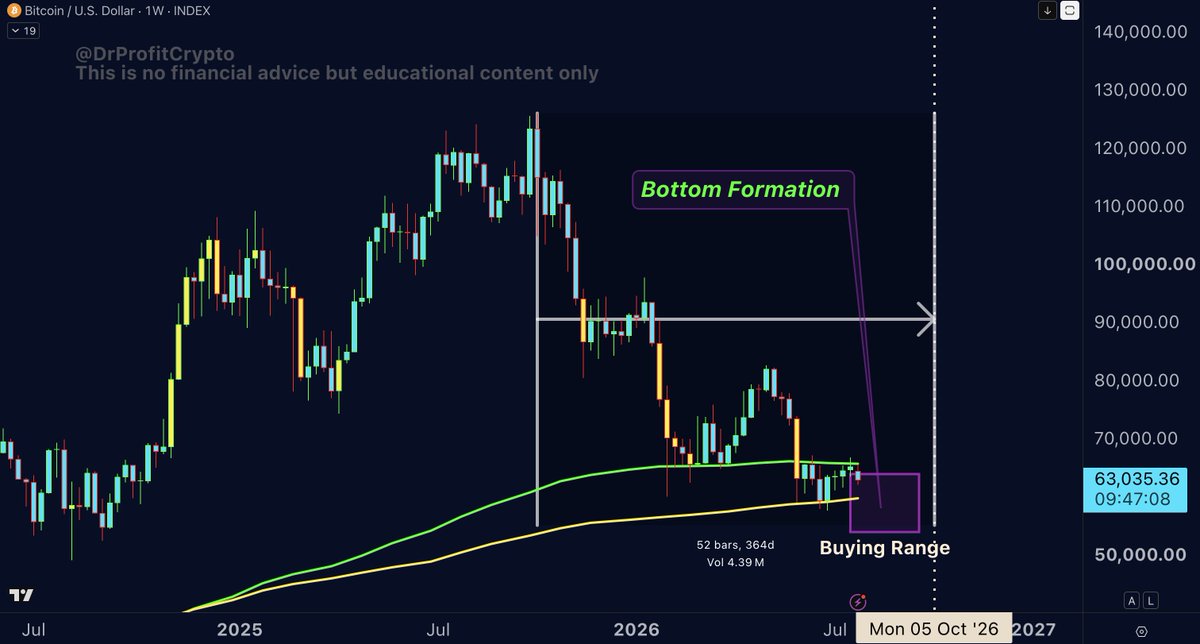
Looking at $BTC, it seems like there's more than just one final drop.
If we were to replicate the "three" phase in the chart, it would only be the beginning.
You're telling me to buy the dip? What kind of dip are you talking about? 🥶
342
0
0
31
SOL I don't understand
2h ago
Follow
After reviewing the expenditures of the six major companies, what I want to say isn't that big companies are burning through cash again.
Rather, the market's assessment of AI is shifting from one question to another:
Previously, the question was:
"Will AI capital expenditures be too high?"
Now, the question is:
"If we don't continue investing, will our computing power be insufficient?"
This is the core reason for the recent strong rebound in storage, HBM, and semiconductors.
Several changes make this clear.
Google raised its 2026 Capex guidance from $180-190 billion to $195-205 billion.
Meta initially only gave $115-135 billion, but subsequently revised it upwards, and it's now at $130-145 billion.
Intel continues to increase its investment in advanced process technologies, foundry services, and packaging capacity.
Tesla is also continuing to invest in Dojo computing power, robotic production lines, and factory expansion.
While Microsoft slightly lowered its full-year capital expenditure forecast from $190 billion to $175 billion due to accounting adjustments, the key point isn't that it's stopped investing, but rather that its investment in AI hardware and computing power hasn't shrunk; the overall scale of investment remains far higher than last year.
This illustrates one point:
The AI capital expenditure cycle is still being forcibly pushed forward.
Moreover, this round of investment isn't simply about buying a few GPUs.
Behind an AI data center lies an entire industry chain:
GPU/ASIC chips
HBM high-bandwidth memory
Server DRAM
Enterprise-grade SSDs
Advanced packaging
Optical modules
Power equipment
Liquid cooling
Data center land and power grid
So why has the storage sector rebounded so strongly recently?
Because the market suddenly realized:
If cloud providers continue to expand AI data centers, then storage demand is unlikely to cool down quickly.
Companies like Micron, SK Hynix, and Samsung are no longer just traditional DRAM cyclical stocks.
They are now more like "capacity sellers" in the AI infrastructure chain.
GPUs are responsible for computing.
HBM (Hardware Bus) feeds the data.
DRAM handles the operation.
SSDs store the data.
The larger the data center, the more exorbitant the storage consumption.
Previously, the storage industry focused on smartphones, PCs, and inventory cycles.
Now it's different.
Now we need to look at:
Google Cloud growth;
Microsoft Azure growth;
Meta data center expansion;
Tesla robotics and self-driving technology;
AI inference throughput;
HBM supply and demand gap;
Enterprise-grade SSD prices.
This is why storage stocks rebound so sharply.
Because the market was previously focused on two expectations:
First, whether the AI caps had peaked;
Second, whether the storage price surge would end.
Now, with the release of major companies' earnings reports and guidance, the market has discovered: money is still being poured in, demand is still there, and capacity expansion hasn't stopped.
Therefore, the previously suppressed storage valuations will quickly recover.
But investors should remain calm.
A sharp rebound doesn't mean there are no risks.
The biggest problem in the AI hardware chain right now isn't a lack of compelling narratives, but rather overly optimistic expectations.
If cloud providers slow down their Capex projections, or storage prices stall, stock prices will likely plummet.
Therefore, my focus in this sector isn't on whether to chase it or not.
The key is to look at three things:
Are major vendors continuing to revise their Capex projections upwards?
Are HBM/DRAM/SSD prices continuing to improve?
Can cloud revenue prove that the money spent isn't wasted?
If all three remain intact, the storage theme hasn't been disproven.
If any one of these weakens, you need to reassess your position.
This storage rebound, superficially a stock price correction, is actually driven by the ongoing global AI capital expenditure cycle.
Short-term prices are driven by sentiment.
Mid-term prices are driven by rising prices.
Long-term prices depend on whether AI data centers can sustain their expansion.
445
0
0
33
The Bitcoin Historian
2h ago
Follow
The former president of PayPal just stated that the "Clarity Act on Bitcoin and Cryptocurrencies" must be passed immediately; this is crucial.
"We need clear rules for the United States."
"We need to continue leading the global financial system."
He believes that once the bill becomes law, all U.S. banks will quickly adopt it.
The Clarity Act must pass this week! 🔥
326
0
0
36
Cointelegraph
3h ago
Follow
🚨Latest news: OpenAI has reportedly discovered more security vulnerabilities in its ongoing investigation of hacking attacks, specifically affecting its AI agent security.
Just how many vulnerabilities are there?
382
0
0
45
The Bitcoin Historian
3h ago
Follow
Perspective: In 2010, you bought Bitcoin for $0.30.
At the time, you had no idea you were about to create generational wealth.
You didn't know that one day nations would adopt it as a reserve asset.
You didn't know that companies would include it on their balance sheets.
You certainly didn't know that entire countries would legislate to adopt it.
Right now, it's just a magical internet currency.
But you've already seized the opportunity and are about to witness the biggest monetary revolution in history! 🔥
458
0
0
42
Honest Mr. Mai
4h ago
Follow
The recent events involving Gate.io and BitMart should serve as a wake-up call for all those still holding money on smaller exchanges. In the next year or two, we should see the vast majority of small and medium-sized exchanges go bankrupt. This is because the business model of altcoins, on which these smaller exchanges relied for survival, has ended. When they close, your money will most likely no longer be yours. Don't be lazy, don't take chances, and don't be attracted by a little extra investment returns—those are just bait to lure you in.