

Foreign media, citing data from Santiment, reported that the DeFi sector has recently shown a clear divergence. DeXe and Injective have become among the DeFi tokens with the largest inflows into exchanges since 2026, while Curve and Uniswap have seen significant outflows. This change indicates that funds have not withdrawn from DeFi as a whole, but rather are being redistributed within the sector.
DEXE and INJ saw the largest inflows.
The article mentions that DEXE surged by over 115% in early July before quickly falling back, with a cumulative drop of over 85%. Santiment tracked that the pullback in DEXE was accompanied by large inflows into exchanges, which usually means an increase in the number of tokens available for sale and rising pressure for profit-taking in the market.
Injective is showing similar signs. Data shows that approximately 1.8 million INJ tokens have recently been transferred to exchanges, ranking among the top major DeFi tokens. The article argues that this means INJ may face selling pressure from profit-taking if the upward momentum continues to weaken.
CRV and UNI experienced significant outflows.
In contrast to the two mentioned above, CRV and UNI have recently seen significant outflows from trading platforms. Santiment data shows that approximately 9.8 million CRV and 8.4 million UNI have been transferred out of exchanges.
The article points out that outflows from exchanges typically mean that holders are transferring tokens to self-custodial addresses or using them for staking, thereby reducing the circulating supply available for short-term sale. This also suggests that the current market is more like a rotation within a sector than a general bearish sentiment towards DeFi assets.
DeXe fell as selling pressure increased.
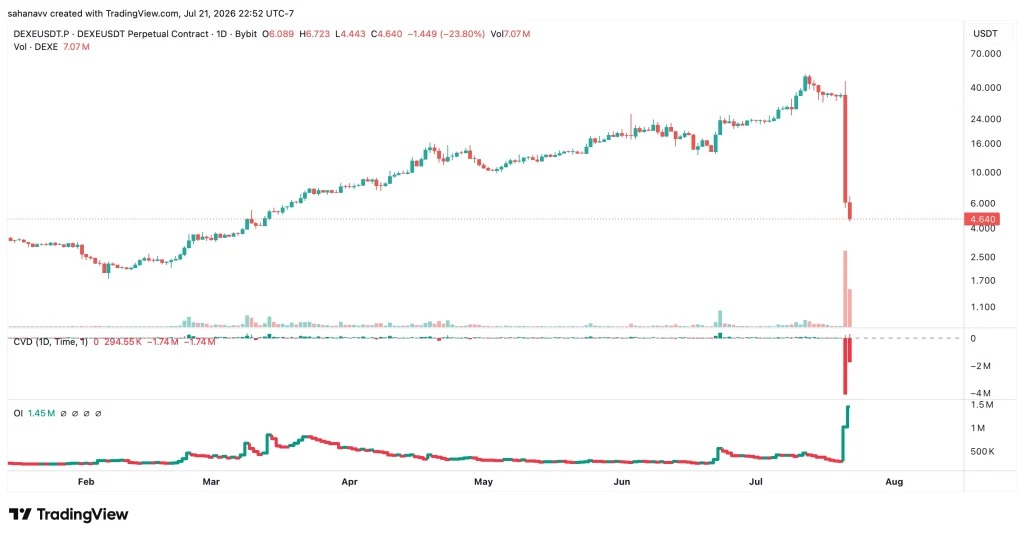
The article states that DeXe quickly fell below $49 after rising to above $49, dropping nearly 24% in a single day to around $4.64. During the decline, trading volume increased significantly, indicating a concentrated release of selling pressure rather than a slow pullback.
Meanwhile, CVD (Continuous Volatility Dividend) showed a significant decline, reflecting an increase in active selling orders. Open interest also rose to multi-month highs as prices fell. The article argues that this typically indicates new leveraged positions entering the market during the decline, rather than simply existing positions being passively liquidated.
Based on signals such as exchange inflows, increased trading volume, weakening CVD, and rising open interest, the article concludes that DeXe's pullback is not merely a technical consolidation, but rather a sign of significantly increased selling pressure. If INJ continues to exhibit a similar combination of capital inflows and weakening momentum, the market may further scrutinize whether it replicates DeXe's correction path.