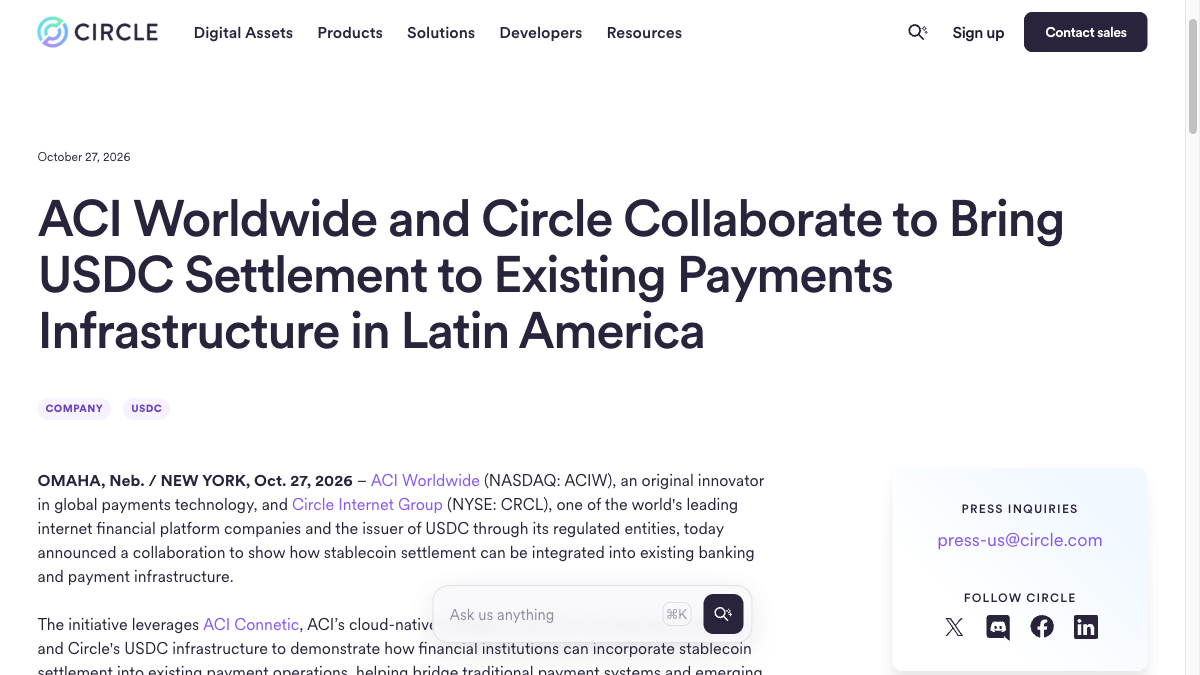


A bank wants to trial USDC for settlement, and the entry point may not necessarily be to create a new wallet. ACI Worldwide and Circle announced a collaboration on October 27th, through the payment orchestration platform ACI Connetic, to demonstrate how stablecoin settlements can be integrated into existing banking and payment infrastructure. Initially focusing on Colombia, the key terms in the news were pilot projects and evaluations, rather than indicating that users across the country had already switched to online payments.
The announcement places this attempt next to Bre-B. ACI has built the central infrastructure that supports Colombia's interconnected instant payment ecosystem, and Bre-B lays the foundation for real-time payments from account to account across the country. The collaboration explores how USDC can complement the existing system, rather than trying to rewrite Bre-B itself into a stablecoin blockchain.
For payment users, whether a transfer from one account can be initiated and how the settlement is completed with the institution are two separate aspects that need to be understood separately. The focus of this announcement lies within the existing operational environment of financial institutions: how digital dollars can operate in conjunction with existing payment systems, fund management, governance frameworks, and settlement processes. It does not require each payer to first understand the underlying network.
Already made an instant payment, so why try stablecoins?
If we only compare "whether transfers can be faster or not," this collaboration could easily be misconstrued as a case of technological substitution. However, the goal proposed in the announcement is multi-track orchestration. Connetic brings together traditional payment methods, digital assets, and card payments on a cloud-native platform, allowing institutions to evaluate different settlement models within a familiar environment.
The implication of this arrangement is that institutions already have a set of business systems in place before adopting the new framework. They need to understand how funds enter, how to record them, how to coordinate with financial operations, and how governance will continue. Stabilized coins can only become an option within the existing processes if they can be integrated into the same platform; however, this only proves that tokens can be transferred, and it still does not address how institutions will use them on a daily basis.
Circle provides the infrastructure for USDC, while ACI offers an orchestration platform and an existing payment technology environment. The roles of both parties have not merged due to this collaboration. For the adopters, stablecoin assets, payment pathways, and organizational operations remain at different levels; the announcement does not disclose the details of individual fees, supported chains, or rules for fund inflows and outflows, making it impossible to provide users with a complete and executable exchange route.
One point in the material that changes understanding is: although USDC is being piloted, Connetic is not described as a system dedicated to USDC. The announcement clearly states that it supports the evolving payment networks, digital asset providers, and future settlement models. Circle has gained an opportunity to enter institutional workflows, while ACI continues to play a role in coordinating various payment options.
This will affect the entry points for competition. For financial institutions, new assets need to be attractive not only in themselves but also need to be able to be processed by existing systems. For infrastructure providers, the value lies in being able to handle different tracks and allowing institutions to compare them. This analysis is based on the division of labor described in the announcement and does not imply that either party has disclosed the commercial charging methods or exclusive cooperation terms yet.
What is being piloted and verified is collaboration; it cannot be scaled up by leveraging the national network.
Colombia was chosen as the initial focus, providing a specific environment with an existing instant payment infrastructure. However, the “initial focus” does not provide a timeline for widespread promotion. The announcement also does not offer a list of participating banks, the number of transactions completed, the settlement volume, or an entry point for individuals to use these services. The existence of a national real-time payment system cannot be counted as the actual adoption volume of this USDC pilot project.
Therefore, when reading about the pilot demonstration, the most useful information is what it attempts to verify: whether the same platform can combine stablecoins with traditional financial systems, allowing institutions to evaluate them in a familiar operating environment. If it were simply stated as "stablecoins enter Latin American banks," the status of the product would be omitted, as well as the most specific target of this attempt.
For corporate finance teams, the continuation of existing processes is not trivial. The materials directly list three organizational requirements for fund management, governance, and settlement. This indicates that the focus of cooperation includes who can choose the approach, how to integrate into existing operations, and how institutions will conduct evaluations. The news does not state that these requirements are already met by all banks, nor does it promise that any cross-border payment will be credited immediately.
Similarly, the fact that USDC is issued by a regulated entity Circle only indicates the issuance arrangements stated in the announcement; it cannot be used to infer the licensing status of each adopting institution within their respective jurisdictions. The scope of the pilot program, the issuing entities, and the operational conditions of the institutions themselves need to be understood according to their individual circumstances, and a single compliance label cannot be used to judge all participants.
The change that has occurred currently is that stablecoin settlements now begin to be evaluated by institutions through existing payment orchestration channels. Banks do not need to completely replace their existing systems, and infrastructure providers have not abandoned traditional payments either. The option of incorporating these new methods into existing workflows still requires that costs, responsibilities, and settlement conditions be implemented item by item for each specific institution and path.