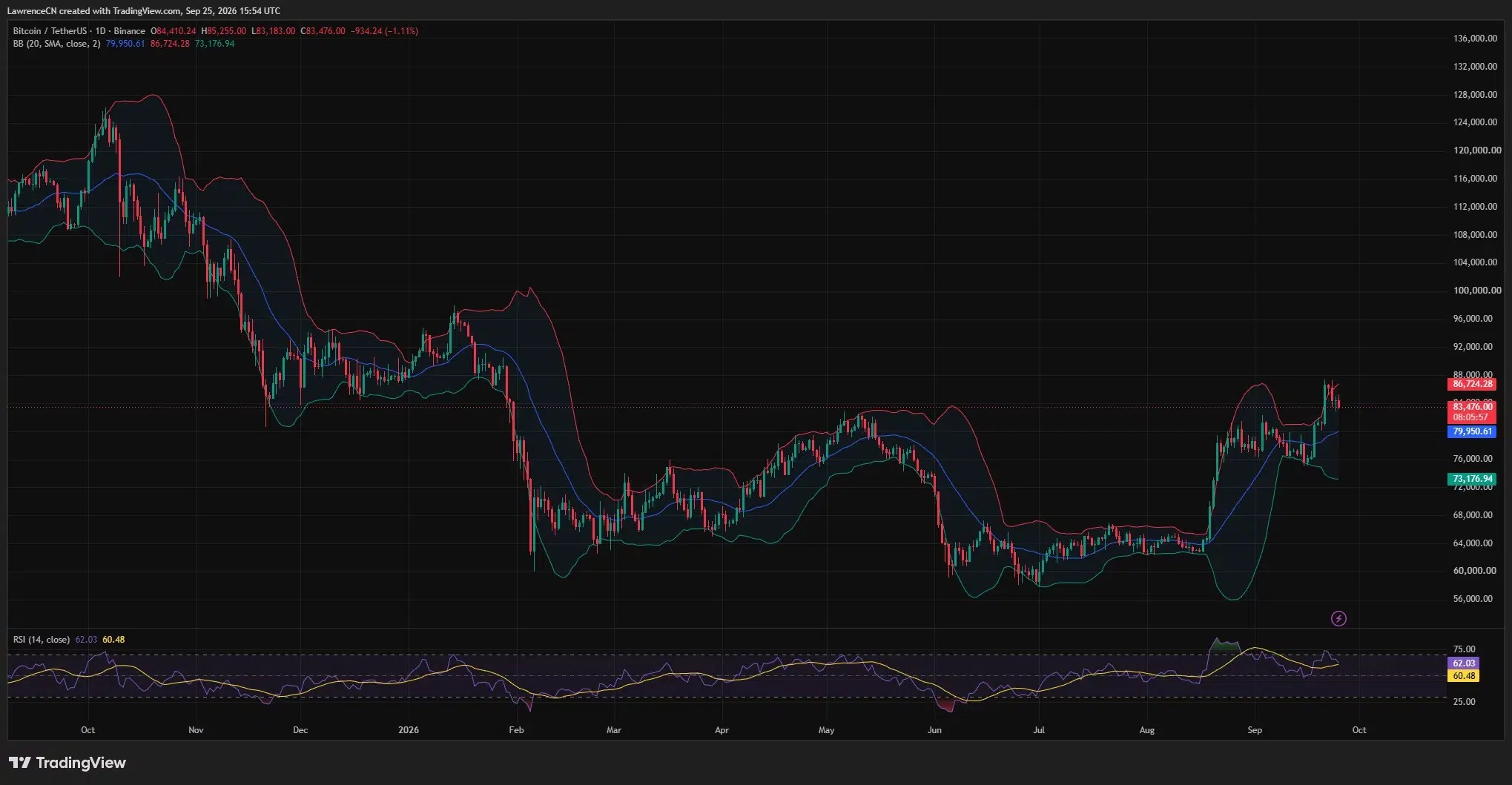
Bitcoin fell below $77,000 during the sell-off on October 30th. Previously, Binance estimated that it encountered a $6.3 billion security vulnerability. Traders are watching to see if buyers can hold the support level and push back above $80,000.
- The downward channel of Bitcoin has made the support range between $76,200 and $76,800 a focal point, following a security incident that occurred at a exchange earlier on.
- Blockaid Tracked at least $3.5 billion flowing out of the Binance wallet within an hour, involving four blockchain networks.
- Nansen has discovered that stolen stablecoins are being used as collateral to borrow ETH through Aave.
- Experts say that withdrawal permissions, reserve verification, and transaction liquidity will determine whether a contagion effect will occur.
Binance Market data shows that Bitcoin reached $76,944 not long after midnight on UTC, and then rebounded to nearly $78,000 during the day's trading. This security vulnerability in the exchange has drawn attention to both the amount of funds that were stolen and the potential pressures that customers, lenders, and market makers may face if they withdraw their funds.
In subsequent updates following Reuters, Binance indicates that more than $6.34 billion of company funds have been reserved, including $5 billion in affected token assets. Partners have frozen approximately $3 billion, which is calculated separately from the aforementioned reserves.
Bitcoin buyers face a test in a downward channel
From a technical perspective, Token Talk marked the price of Bitcoin at around $78,300 on the chart for October 30th, which is above the support range of $76,200 to $76,800. The analyst noted that in the past few weeks, Bitcoin has continued to set lower highs within a descending channel, while buyers have entered the market several times near the lower edge of this channel.
The post claims that for a rebound to occur, Bitcoin needs to once again reach $80,000 and break through the upper channel boundary. If this trend is realized, the range of $84,000 to $86,500 could become a focus again.
Rekt Fencer offers a more optimistic interpretation, stating that the bottom of Bitcoin has been formed. His weekly chart marks the FTX collapse, the Bybit hacking incident in 2025, and this recent Binance event, but the post does not provide any separate confirmation that the selling pressure has ended.
The research leader, Bitget Wallet, and Lacie Zhang stated that the range of $76,000 to $77,000 is an important level that needs to be maintained. She said that if spot demand continues to drive Bitcoin back above $80,000, it would indicate that the market is trending towards stability.
Binance Wallet takeover exposes withdrawal control issues
Preliminary analysis by Blockaid indicates that at least $3.5 billion was transferred out of the hot wallets of Binance, Arbitrum, Optimism, and Avalanche on Ethereum within less than an hour.
Blockaid, Co-Founder and CEO, Ido Ben - Natan stated to crypto.news: "The attackers actually reprogrammed a major Binance Ethereum hot wallet, allowing a single operator to transfer all the funds away, including any new funds that were deposited later on, and they exploited this access again more than an hour later."
He stated that his team discovered that the attackers had made financial preparations through Tornado Cash several hours before the theft and practiced on a test wallet.
Although the initial investigation pointed to an intrusion into the laptop of an engineer with the username DevOps, according to reports from AFP, Binance later revealed more points of intrusion. The company described this as a complex attack, meaning that this laptop was just one of the initial findings and not a complete explanation of the incident.
The CEO Stefan Deiss stated to crypto.news that trusted access requires independent control. His recommendations for financial AI agents include: verified identities, accountable human operators, expenditure limits, and the ability to turn features on and off.
Nansen Tracing the flow of stolen funds Aave Borrowing and lending
Analysis shared by Nansen to crypto.news shows that 18,270 BTC amounting to approximately $1.48 billion were transferred from a hot wallet at Binance to 19 different wallets through a central address. At the time this analysis was prepared, these funds had not been transferred again.
On Ethereum, the attacker deposited approximately 60 million US dollars into Aave and borrowed ETH worth 43.5 million US dollars, as discovered by Nansen.
In the wallets associated with the attackers, the institution identified 442,000 ETH. Two of these addresses held 197,500 ETH and 137,600 ETH respectively. Another wallet transferred 14,000 ETH.
The investigation traced assets amounting to $414 million, including WBETH, ENA, RLUSD, UNI, PEPE, and LINK. These assets were exchanged for tokens on decentralized exchanges through 11 wallets. $823 million of USDC has been frozen, while one wallet still holds 233.46 million XRP, valued at approximately $297 million.
The data for Nansen reflects the positions held and transactions that were tracked at the time of reporting, rather than a new estimate of the total losses for Binance.
The pressure to withdraw money may persist after the initial theft.
Zhang indicates that the baseline scenario of Bitget Wallet is not a systemic crisis. However, if the withdrawal restrictions continue, or if there is doubt from the outside world about the reserves, lenders and market makers may withdraw. The decoupling of stablecoins from their underlying assets and a deterioration in market depth would be warning signs.
Truth Ventures, the founder and CEO, stated to Varun Datta that solvency and operational accessibility are two different issues.
Datta said, "The emergency fund can compensate for the lost coins, but it cannot address all the reasons that may lead to the suspension of withdrawals."
He pointed out the mis-matching of assets in emergency reserves. According to his example, if a fund holds Bitcoin worth $1 billion but owes $1 billion in stablecoins, then a shortfall of $100 million will occur after Bitcoin falls by 10%.
The Chief Technology Officer of the self-hosted service provider Tangem, Andrew Lazutkin, stated that offline wallets can reduce the risk of exchanges being attacked, but users still need to bear the risks of phishing and malware on their own.
ISACA Chief Global Strategy Officer Chris Dimitriadis warned that criminals could exploit this incident to carry out attacks by urging users to take immediate action. He told crypto.news that the board of directors should regard cyber risks as a continuous priority and ensure that employees are able to identify targeted attacks.