




The U.S. Senate is scheduled to vote on a procedural motion regarding the Clarity bill at 2:15 p.m. Eastern Time on Tuesday. This is not the final approval stage, but if a majority of 60 votes cannot be obtained to conclude the debate, it will be very difficult for the bill to proceed to committee review, and the chances of making further progress within 2026 will significantly diminish.
Lumis claims to have incorporated over 120 modifications.
Wyoming Republican Senator Cynthia Lummis stated that the latest revised text has incorporated more than 120 requests put forward by Democrats, including new ethical restrictions. She said that these arrangements cover the president, vice president, members of Congress, and federal judges, with the aim of gaining cross-party support.
Lumis posted on a social media platform stating that the "Clarity Act" has reached a stage where "it's not easy now, and it will be even more difficult in the future." She later told the media that if the procedural vote on that day fails, this act will essentially come to an end this year.
The bill focuses on the division of labor between SEC and CFTC.
The "Clarity Act" is regarded as a market structure bill that the US crypto industry has been advocating for a long time. Its focus is on delineating the regulatory responsibilities of the US Securities and Exchange Commission (SEC) and the Commodity Futures Trading Commission (CFTC) regarding digital assets, and it provides clearer regulatory designation for the majority of tokens.
The House of Representatives passed its version in July 2025. The Senate Banking Committee then passed the bill in May 2026 with a vote of 15 to 9, but at that time only two Democratic senators supported it. This Senate vote was regarding the cloture motion for H.R .3633, which is to end the debate and move on to the next stage.
- The Republican Party currently holds 53 seats in the Senate.
- Procedural motions usually require 60 votes to pass.
- The Republican Party still needs to win the support of about 7 Democratic lawmakers.
Differences remain even after the White House makes concessions
To gain more support, the White House agreed to add new restrictions that prohibit federal elected officials, judges, and their spouses from issuing or initiating digital asset projects. These restrictions are authorized to be enforced by state attorneys general, with no set expiration date.
However, some Democratic senators still believe that the revisions are not sufficient. Senator Elizabeth Warren and others question that there are still gaps in the implementation of the existing ethical provisions, and the coverage of Trump family-related crypto businesses is not clear enough. Other Democratic senators continue to focus on consumer protection and anti-illegal financing provisions.
Predicted market and coin price to fall in tandem
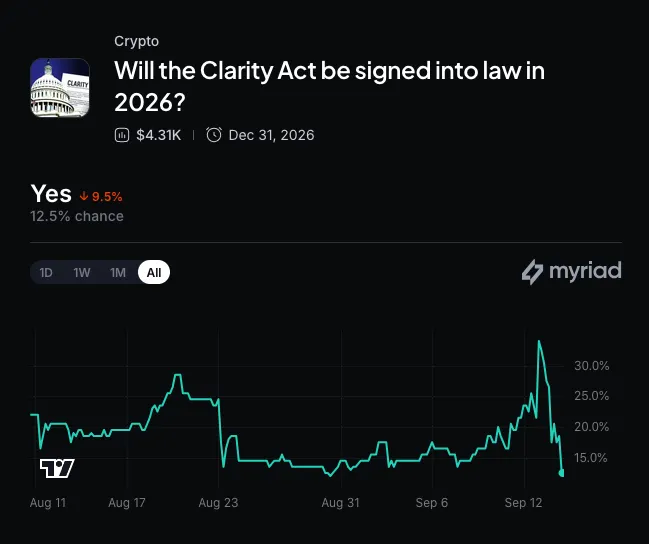
Predictions for market volatility this week are high surrounding the prospects of the bill. On Polymarket, the probability that the Clarity bill would become law within 2026 once rose to 35% on Monday, but it fell back to 19% on Tuesday after the Democratic Party proposed an alternative plan. The market also expects that the probability of more than 50 votes in favor on that day is higher than the probability of passing with a threshold of 60 votes.
The crypto market is also affected by uncertainty. Bitcoin has fallen below $77,000, and Ethereum has also seen a decline in tandem with XRP. Over the past 24 hours, the total liquidation volume across the market was approximately $637 million, with long positions accounting for a larger proportion of liquidations, indicating that short-term risk appetite is cooling down.