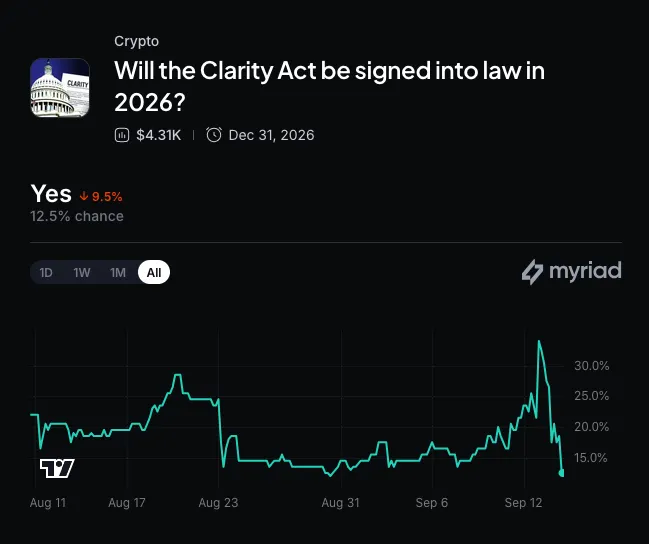





The U.S. Senate failed to make it happen. Clarity Act Crossing the final threshold of 60 votes, this has set back the efforts of the crypto industry to promote legislation on market structure. Several industry executives believe that the outcome is disappointing, but it does not mean that digital asset regulation in the United States will regress, nor will it cause institutional development to stop immediately.
Regulatory processes are still underway.
It is generally believed in the industry that SEC and CFTC are already advancing their respective digital asset rule initiatives, and these processes do not entirely depend on the results of this vote. What the market is more concerned about is the stability of these rules.
If we mainly rely on regulatory agencies to set rules, then in the future, after a change of government, the relevant arrangements may be revised again. In contrast, if a framework is established through legislation by Congress, it will be more sustainable and it will also be easier to encourage banks, asset management institutions, and large enterprises to make long-term investments.
Enterprises worry about the prolongation of uncertainty
Some of the executives interviewed mentioned that the failure to advance the bill means that companies will still face a period of uncertainty in their 2027 budgets, compliance, and product planning. When institutional funds lack a clear legal framework, they often need to assess counterparties, asset attributes, and compliance responsibilities on an individual basis.
Some industry insiders also compare the United States with Europe. The EU's MiCA has already provided a relatively clear set of rules, so if U.S. legislation continues to stagnate, investment and development activities may further flow to regions with clearer regulations such as Europe.
Institutional development will not come to a halt because of this.
Strategy stated on social media that Bitcoin has already established a clear legal and regulatory framework in the United States, including being recognized as a commodity by CFTC, considered property by the U.S. Internal Revenue Service (IRS), and spot Bitcoin products having been approved by SEC.
Institutions such as tZERO and Matter Labs believe that the transformation of the regulated digital asset market has already begun. Even if congressional legislation is temporarily hindered, banks, payment networks, and asset management institutions will continue to advance infrastructure such as tokenized deposits, on-chain payments, and tokenized securities.

- The Senate failed to get the bill over the 60-vote threshold.
- The industry believes that the existing regulatory progress will not reverse in the short term.
- The bigger problem lies in the lack of a legal framework that can be sustained over the long term.
Overall, this setback has slowed down the pace of progress in US crypto legislation, but the industry's reaction has been relatively restrained. Market attention has shifted from whether the bill will pass to whether regulatory authorities can first establish enforceable rules, and whether the US will continue to lose capital and projects due to the delay in legislation.